Dry Creek Bed Installation Services in Bremerton, WA
Dry Creek Bed Installation Kings provides dry creek bed installation, river rock drainage swales, and decorative rock creek bed services in the Bremerton, WA area for both residential and commercial properties, from short downspout runs to long channels that carry yard runoff. Contact us now for a free estimate.
How Much Does Dry Creek Bed Installation Cost in Bremerton, WA?
Dry creek bed installation in Bremerton, WA costs anywhere from $1,190 to $4,760 on average for a 30 to 50 foot residential bed with fabric and river rock. The price depends on the length and width, digging conditions such as clay or rock, the number of boulders, downspout or drain connections, the outlet, and how far rock has to be moved from the truck.
Do You Install Dry Creek Beds at Homes and Businesses?
Yes, we build dry creek beds for houses, townhomes, offices, churches, and other commercial properties. Tell us the property type and whether the bed is for drainage, looks, or both.
Do You Service My Area?
Yes, we cover the Bremerton, WA area. Send us the property address and we'll confirm.
What Should I Plant Along a Dry Creek Bed in Bremerton?
Plants that handle both wet and dry spells. Bremerton averages 56.93 inches of rain a year, with wet winters and warm, dry summers, and the city asks residents to cut outdoor water use when summer demand peaks. We set plants that tolerate runoff low beside the channel and drought-hardy ones on the higher edges, so the planting needs little summer watering.
Will a Dry Creek Bed Fix My Drainage Problem?
Yes, if the problem is surface runoff that needs a path downhill to a safe outlet. If the ground stays soggy for days or water seeps into a crawl space, that's groundwater, and we'd usually suggest a French drain.
Which Is Better for My Yard, a Dry Creek Bed or a French Drain?
A dry creek bed is usually better for runoff crossing the surface, and it's easy to see and clear. We recommend a French drain when water has to move underground, such as soggy clay or seepage near a foundation.
How Soon Can You Install a Dry Creek Bed?
We can usually start once 811 has marked the buried utilities, which typically takes a few business days, and the rock is delivered. Busy spring and fall seasons can push the date out.
What Information Do You Need for a Dry Creek Bed Quote?
We need the address, the rough length you have in mind, photos of where water runs or pools, and where it should end up. Mention downspouts, slopes, clay or rocky soil, and whether a truck can get close.
Will I Need to Be Home During the Installation?
No, as long as we can reach the yard and you've approved the layout. It helps to walk the path with us before digging starts.
Do I Need a Permit for a Dry Creek Bed?
No, most residential beds don't need one. A permit or approval is more likely if the bed ties into a storm drain, discharges at the street, involves major grading, or sits under an HOA, and we can tell you what's usually required.
Can I Get a Price Before the Work Begins?
Yes, we confirm the price before starting. If we hit buried rock, old concrete, or hardpan while digging, we talk to you before doing any extra work.
Do You Price Dry Creek Beds by the Foot?
Yes, installed beds are often priced by the linear foot, typically about $20 to $50 a foot. Wider channels, large boulders, and drain connections add to that.
How Long Does Dry Creek Bed Installation Take?
A small bed usually takes one to three days. Long beds with grading, boulders, drain connections, or planting can take several days.
Can You Connect My Downspouts to a Dry Creek Bed?
Yes, downspouts are one of the most common starting points. We run the water out to the bed and set a flat stone or tight boulders where it lands so it doesn't wash out the rock.
Can You Build a Dry Creek Bed on a Slope or Hillside?
Yes, slopes are where dry creek beds work best. On steep ground we use more cobble and boulders at the bends so fast water doesn't wash the smaller rock downhill.
Can You Build a Dry Creek Bed in a Flat Yard?
Yes, but only if we can create some fall, or the water just spreads out. On very flat lots we shape the grade along the path or end the bed in a dry well.
Can You Build a Dry Creek Bed in Clay Soil?
Yes, but clay soaks up little water, so we run the bed all the way to a real outlet. If a foot-deep test hole still holds water the next day, a creek bed alone usually won't be enough.
Can You Add Boulders to My Dry Creek Bed?
Yes, we set boulders at bends, banks, and the outlet, buried about a third of their height so they stay put. Large boulders often run about $200 to $800 each, so tell us how many you'd like.
Can You Build a Dry Creek Bed Just for Looks?
Yes, a decorative bed can be shallower and narrower than a drainage bed. We still give it a slight fall so rain doesn't sit in it.
Can You Add a Small Bridge Over the Creek Bed?
Yes, we can add a small footbridge or flat stepping stones where a path crosses the bed. Tell us where people usually walk.
Can You Combine a Dry Creek Bed With a French Drain or Catch Basin?
Yes, many yards need both. A catch basin or French drain handles the low spot or soggy ground, and the creek bed carries the water the rest of the way.
Can the Dry Creek Bed End in a Rain Garden or Dry Well?
Yes, a rain garden or dry well is a common outlet when there's no lower spot to send the water. We finish the end with larger rock so it doesn't erode.
Can a Dry Creek Bed Drain to the Street?
Yes, in some towns, where the city allows curb discharge. It can't block city drains, and the local public works office decides.
Can You Run a Dry Creek Bed Alongside My House?
Yes, as long as the ground slopes away from the foundation and the bed carries water away from it. If your yard slopes toward the house, we usually fix the grade first.
Can a Dry Creek Bed Send Water Onto My Neighbor's Yard?
No, we don't end a bed where it dumps water onto a neighbor's property. Tell us where the property lines are so we can plan the outlet.
Can You Fix Erosion Where Rain Washes Out My Yard?
Yes, a dry creek bed is a common fix for washouts and gullies. We follow the path the water already takes and line it with rock that won't move in a storm.
Can You Redo an Old Dry Creek Bed That Stopped Working?
Yes, we can pull the rock, fix the slope or outlet, lay new fabric, and reset the stone. Beds often fail from silt, torn fabric, or no real fall.
Can You Plant Along the Edges of a Dry Creek Bed?
Yes, grasses, sedges, and native perennials that handle the odd soaking soften the banks. We keep plants out of the channel so they don't block the flow.
Do I Need to Call 811 Before You Dig?
No, we request the 811 locate before digging. It doesn't mark private lines like sprinklers, landscape lighting, or septic lines, so point those out to us.
Should I Watch Where the Water Runs Before You Come?
Yes, if you can. A photo or short video during a heavy rain shows exactly where the water flows and pools, which helps us lay out the bed.
Can You Install a Dry Creek Bed in Winter?
Yes, in most cases, as long as the ground isn't frozen. Late spring through early fall is easier, and saturated ground can rut lawns, so we may wait a few dry days.
How Deep and Wide Should a Dry Creek Bed Be?
We dig most drainage beds about 12 to 18 inches deep and two to three times as wide as they are deep. Decorative beds can be 6 to 12 inches deep.
How Much Slope Does a Dry Creek Bed Need?
At least about 1 inch of drop per 10 feet, and 1 to 2 inches is better. We check the grade with a string line so water keeps moving.
What Rock Do You Use in a Dry Creek Bed?
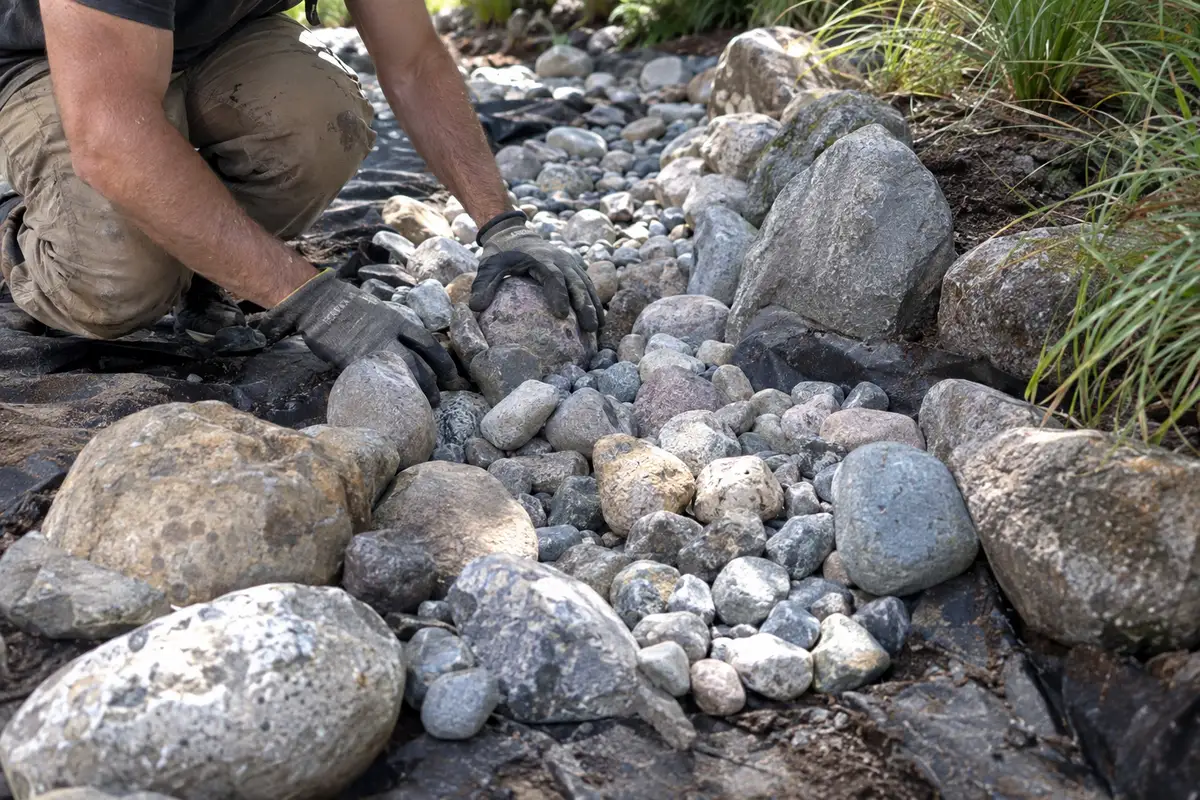
We use rounded river rock in mixed sizes, usually 1 to 3 inch rock in the channel, 4 to 8 inch cobble on the edges, and 12 to 24 inch boulders at bends. Crushed gravel alone tends to wash out.
Do You Put Landscape Fabric Under the Rock?
Yes, we use a non-woven geotextile that lets water through, with seams overlapped. It keeps rock from sinking into the soil and slows weeds, and cheap woven weed barrier tears under the rock.
Do You Need Heavy Equipment for a Dry Creek Bed?
Yes, on larger beds we often bring a mini excavator or skid steer. Small beds and tight backyards can be dug by hand, so tell us how wide your gate is.
Can I Build a Dry Creek Bed Myself?
Yes, a short decorative bed is a fair weekend project. Long drainage beds take tons of rock, a steady grade, and a safe outlet, and that's where we'd usually step in.
Will a Dry Creek Bed Attract Mosquitoes?
No, a properly graded bed drains within hours after rain.
Will Weeds Grow in My Dry Creek Bed?
Yes, a few will, because leaves and soil settle between the stones over time. Fabric keeps most weeds down, and pulling them early keeps it easy.
How Do I Maintain a Dry Creek Bed?
Clear leaves and debris once or twice a year, pull weeds, and reset rocks that shift after big storms. A leaf blower on low works well for clearing the rock.
Do You Haul Away the Dirt You Dig Out?
Yes, or we use it to build up the banks if you'd like to keep some.
